What is the Traumschreiber?
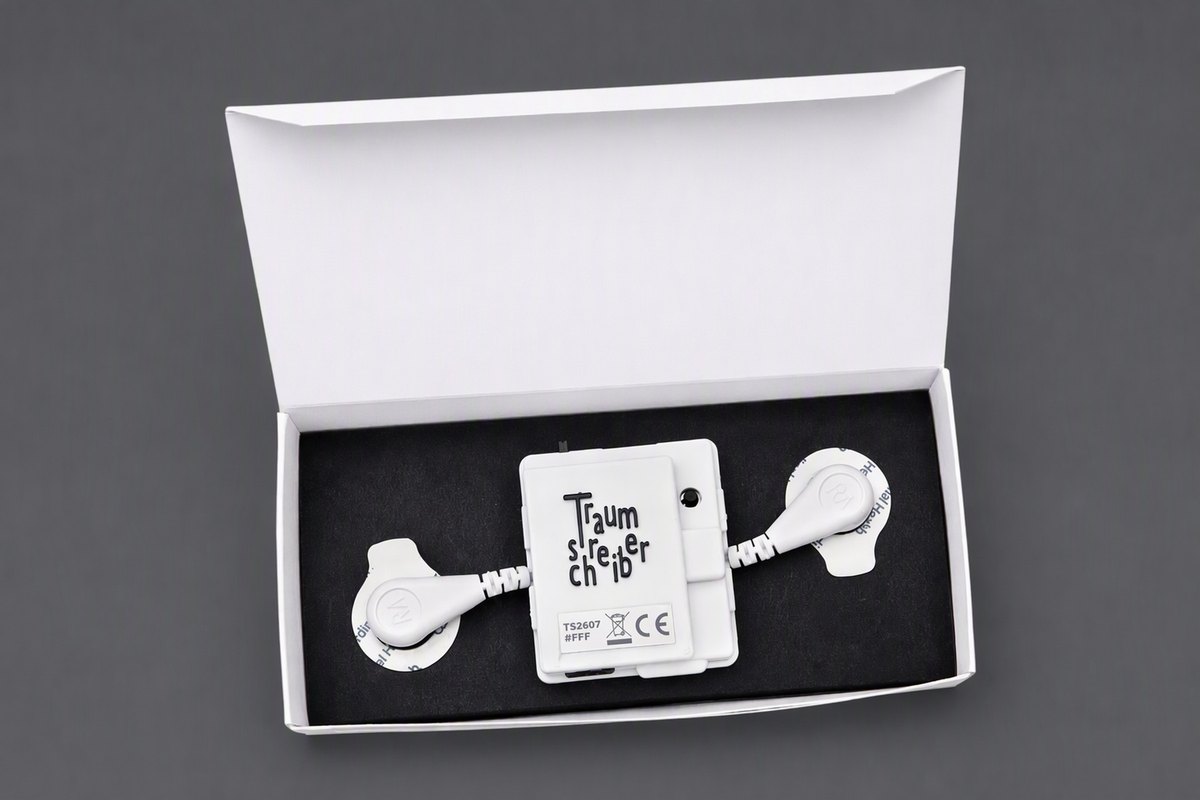
The Traumschreiber is an ExG device: it records the electrical signals that the brain (EEG), the eyes (EOG), the muscles (EMG) and the heart (ECG) produce on the skin. It is worn directly on the forehead with adhesive electrodes and stays in place all night.
How it works
- Stick it on, switch it on, sleep. The adhesive snap electrodes hold the device in the middle of the forehead, just above the eyebrows.
- Saved twice. The recording goes to the microSD card in the device and is sent to the sd20 App on your smartphone via Bluetooth at the same time.
- Open formats. Recordings are stored as EDF/BDF, the standard format of sleep research. You can analyse them with free programs such as EDFbrowser or with our Python scripts.
- More than electrodes. On board are also a microphone, a light sensor, a button, an RGB LED and a small, rather quiet speaker – for light and sound cues during sleep, for example.
- Charging via USB-C. One charge lasts two to three nights. When the battery eventually wears out, it can be replaced without tools.
Not a medical device. The Traumschreiber is intended for education, research, citizen science and self-observation. It is not for diagnosing, treating or monitoring any disease.
Applications
What you can do with the Traumschreiber – with examples from real recordings.
Detect sleep stages automatically
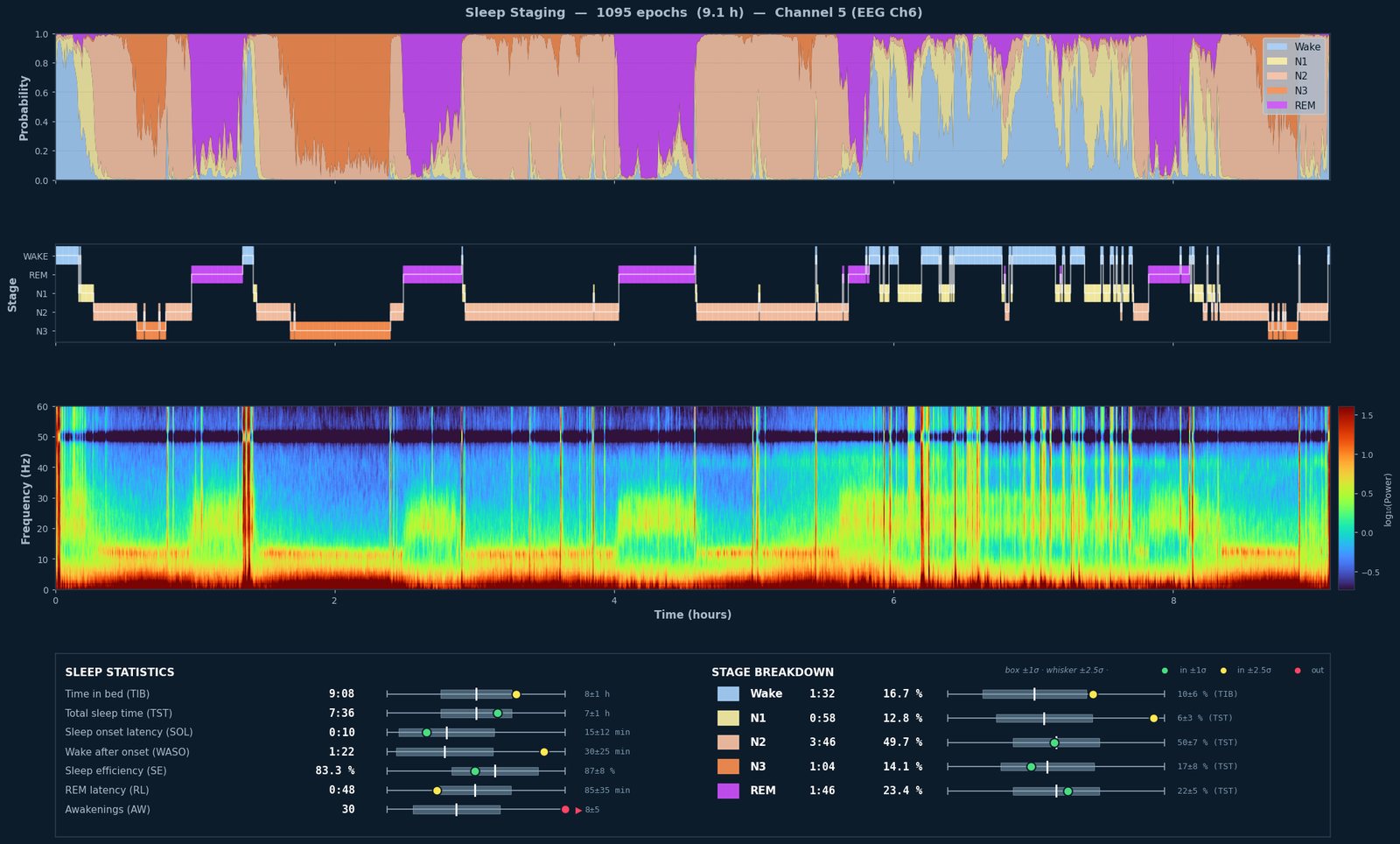
Record a whole night and let an AI divide it into the sleep stages wake, N1, N2, N3 (deep sleep) and REM. For this we use the freely available model AnySleep (Grieger et al., 2025), which works with frontal electrodes like those of the Traumschreiber. On a PC or a smartphone, analysing a whole night takes one to two minutes. The sd20 App shows the sleep stages while the night is still running.
Comparison with the sleep lab: A comparison of the Traumschreiber with polysomnography (PSG), using whole-night recordings from more than 10 participants, is currently under way and is expected to be completed by the end of 2026. The first results look promising.
P300: making attention visible in the EEG
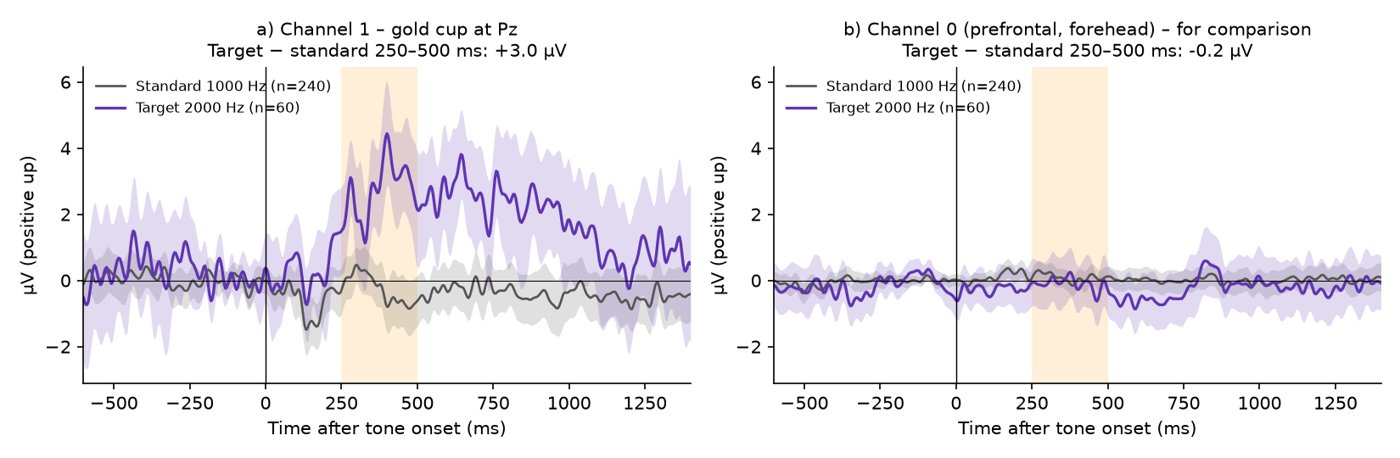
The P300 is a brain response that appears about 300 ms after a stimulus that matters to you. We measured it with the Traumschreiber using a gold-cup electrode on the back of the head (Pz). With 300 tones, of which the participant counted the rare high ones, the response to the target tones was 3.0 µV above the response to the standard tones (p = 0.0002).
In a second task, the app recognised from the EEG which of four colours the person was secretly focusing on (p = 0.039). Both were measurements of one person, a proof of function and not a study with many participants.
The 3 snap + 1 gold-cup configuration is suited for this.
Eye movements and lucid dreams
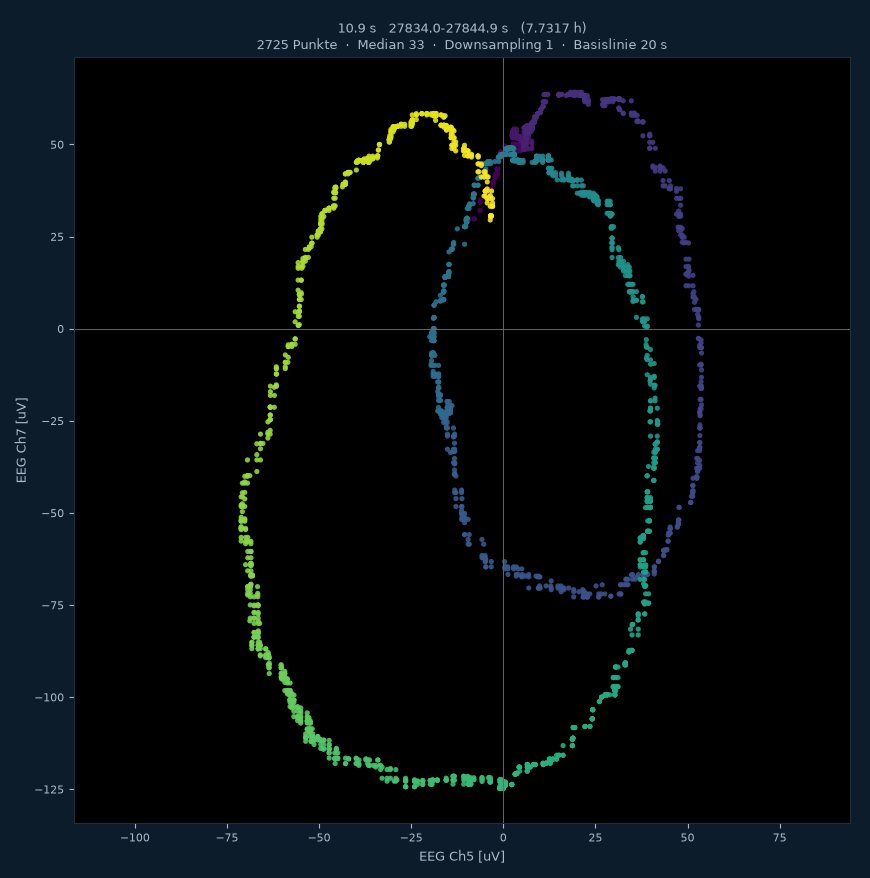
During REM sleep the eyes move. Someone who realises in a dream that they are dreaming (a lucid dream) can control these eye movements deliberately – and so send signals to the outside in the middle of sleep, while the body keeps sleeping.
To paint, you raise a finger in the dream, draw a shape in the air with it and follow the fingertip with your eyes. The real eyes make the same movement. With one horizontal and one vertical EOG channel, the Traumschreiber records it as a two-dimensional path – so the picture is created during sleep, straight from the dream. Our dream painting project builds on this and turns these eye movements into pictures.
For horizontal and vertical EOG: the 3 snap configuration.
And also
Measure biosignals yourself
From the first ECG to brain waves and muscle activity: our tutorial leads in nine levels from switching on to sleep analysis – well suited for school, university and workshops.
Polysomnography light
The PSG version records EEG at F3, C3 and O1, horizontal and vertical EOG and chin EMG at the same time – the signals sleep labs classically use to score sleep.
Ask your own questions
Raw data in open formats, no subscription fees, open scripts: you can plan your own experiments and share your data with others – just as you like.
Configurations, electrode positions and lead layout
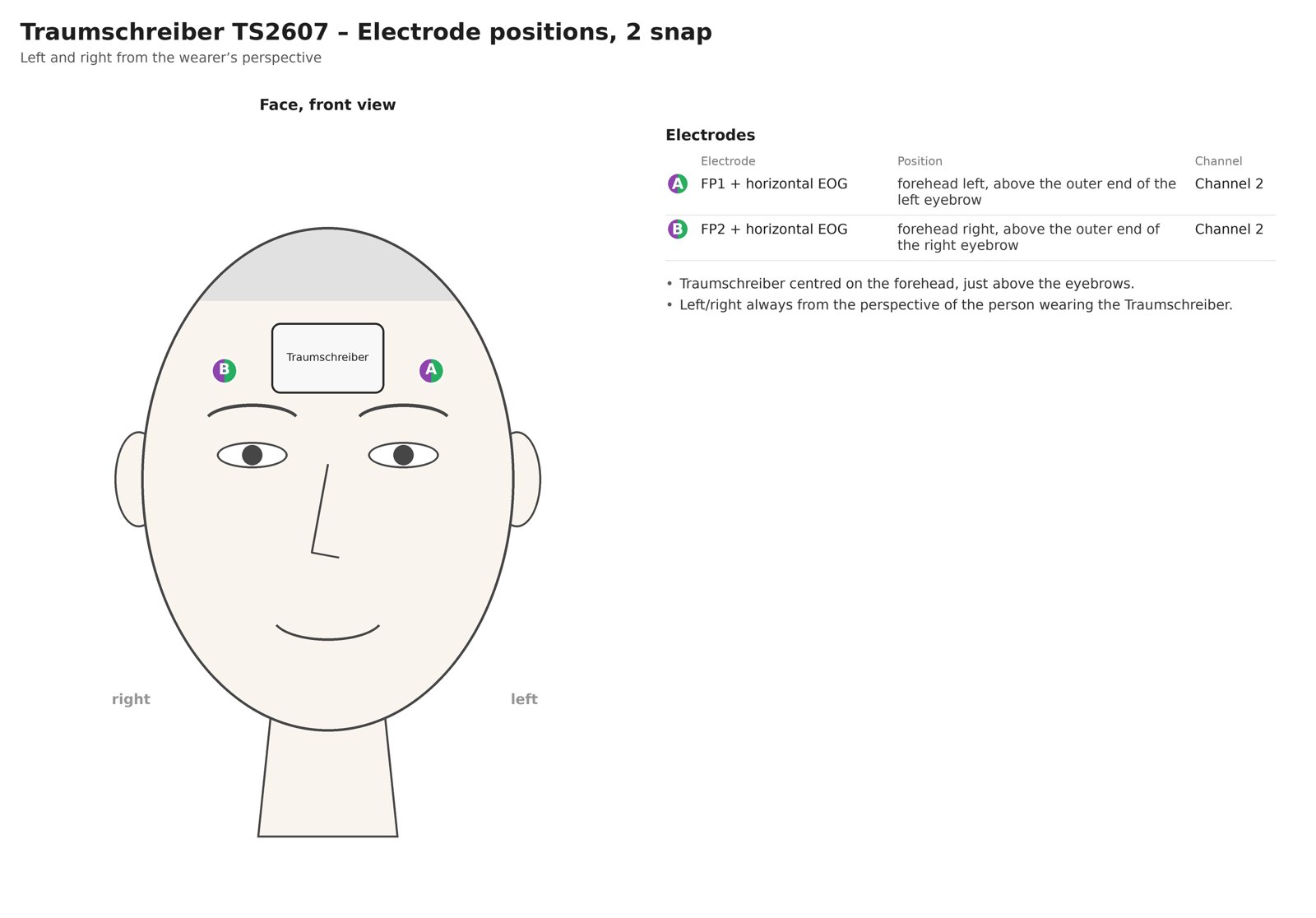
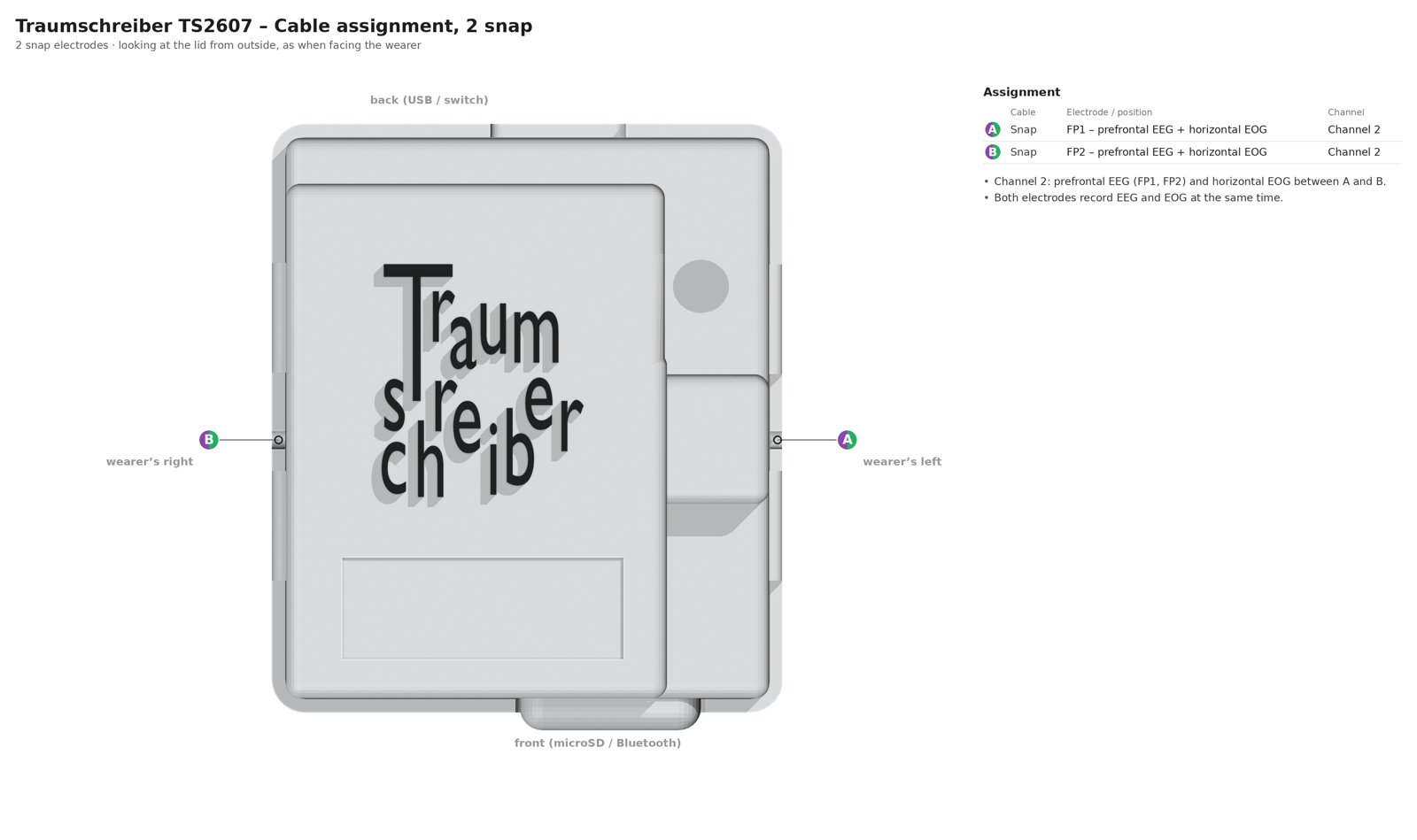
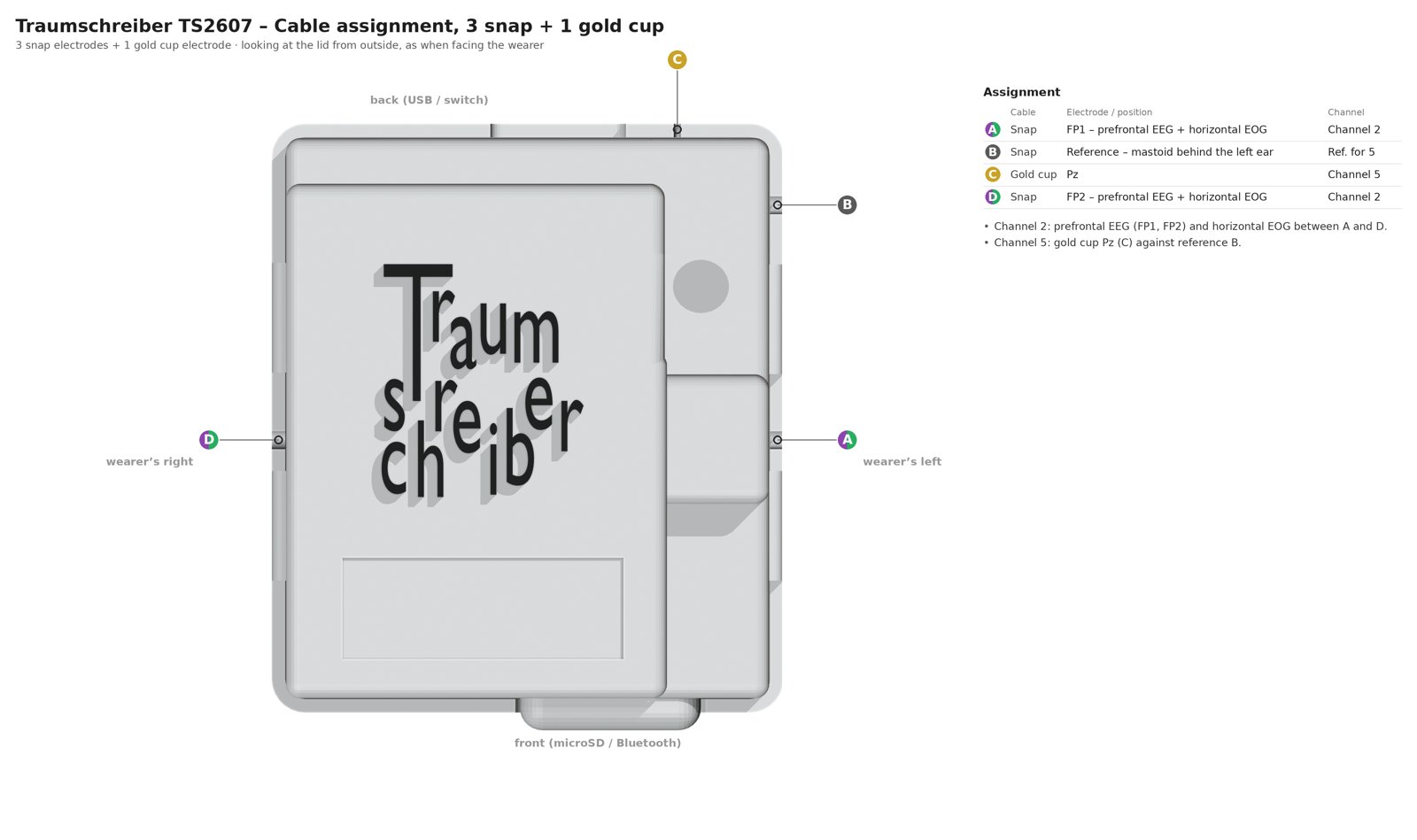
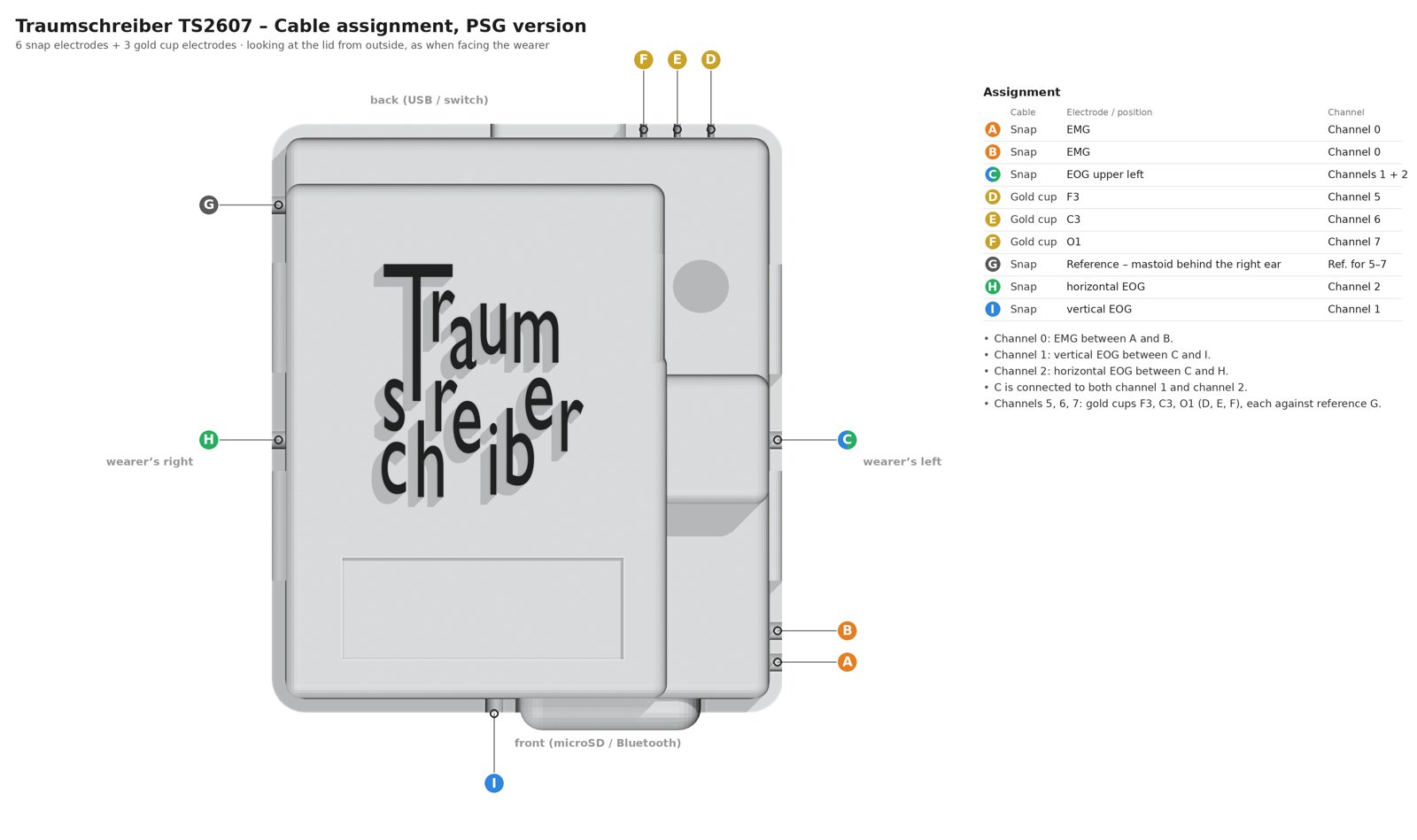
The Traumschreiber has 8 channels. Which of them are used depends on the number of leads soldered on. All sides (left/right) are from the point of view of the person wearing the Traumschreiber. The lead layouts show the device from above, looking at the lid.
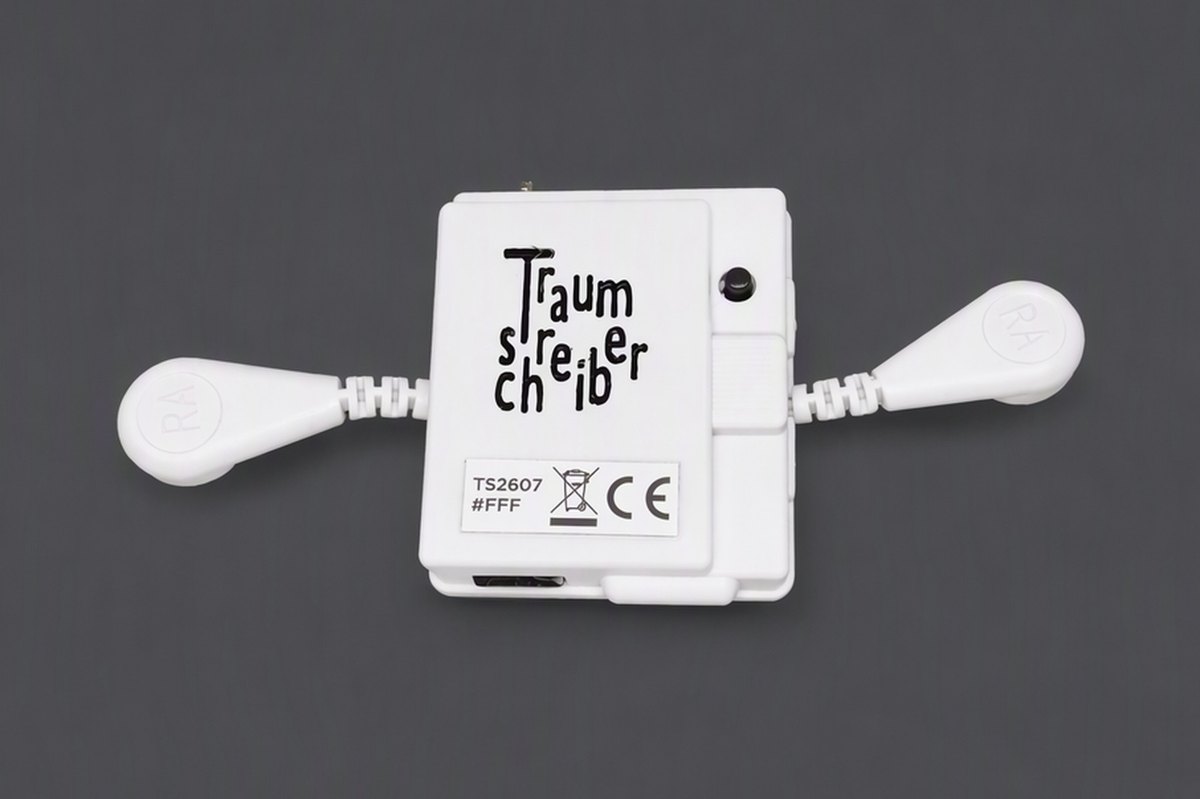
2 leads · one channel. Two snap electrodes on the left and right of the forehead record prefrontal EEG and horizontal EOG at the same time (channel 2). That is enough for automatic sleep staging and for left-right eye signals. The leads are only about 0.5 cm long – the device sits directly between the electrodes.
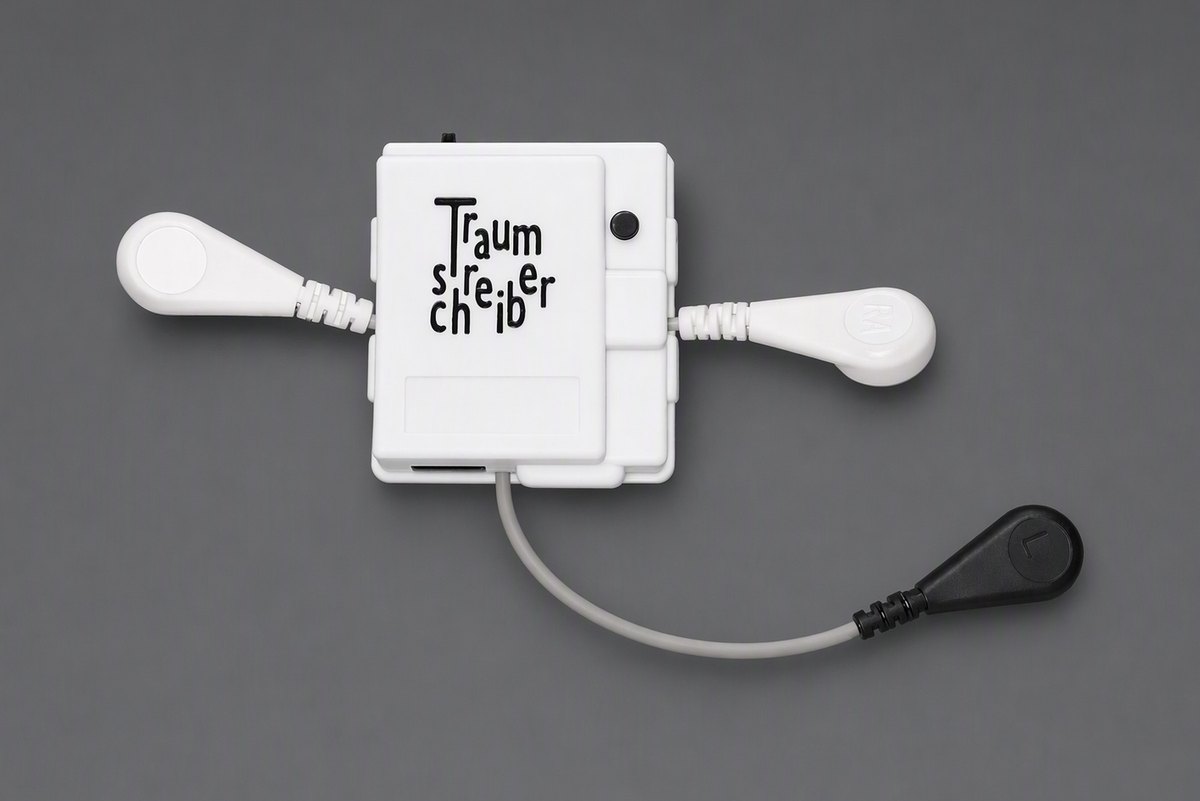
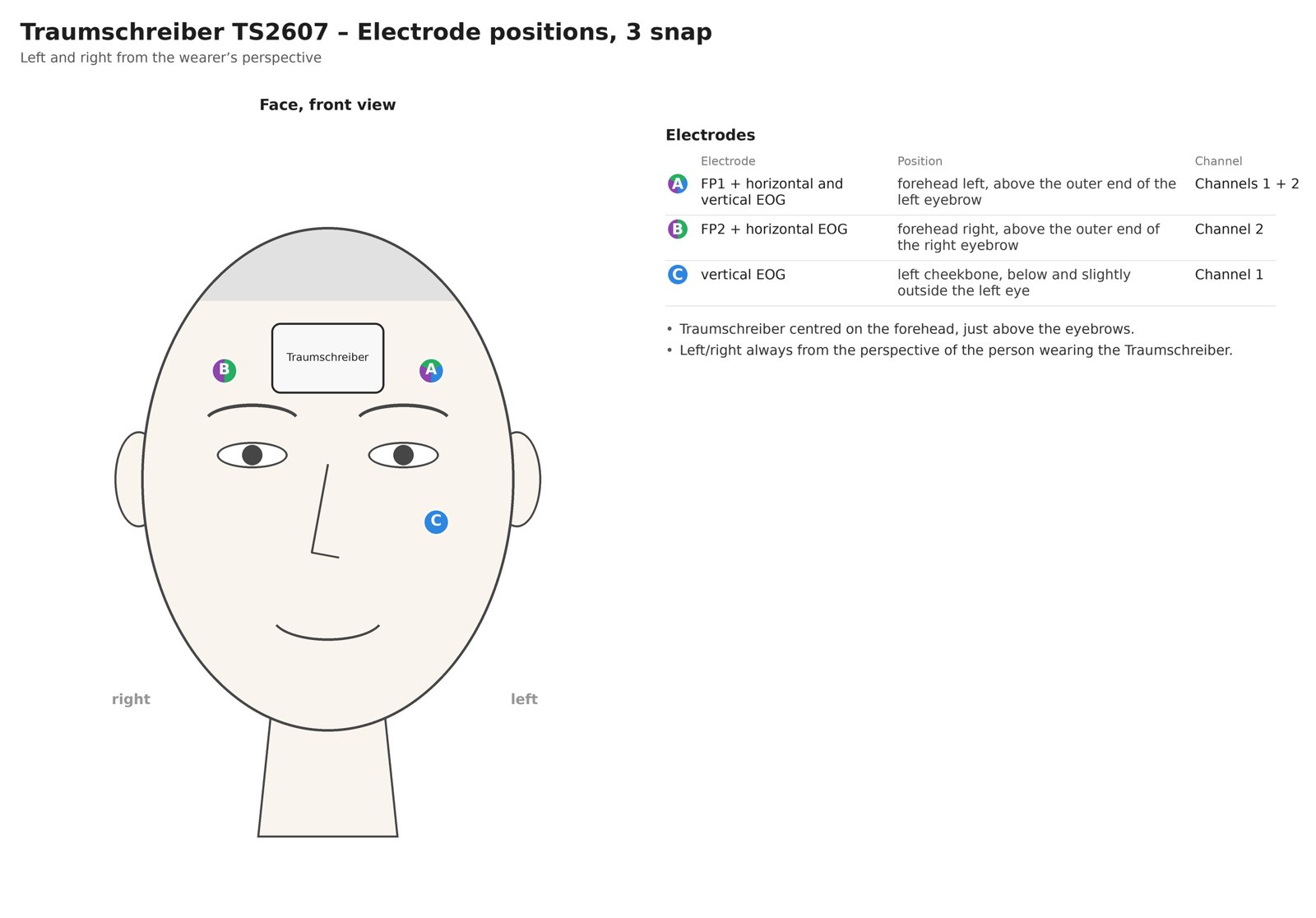
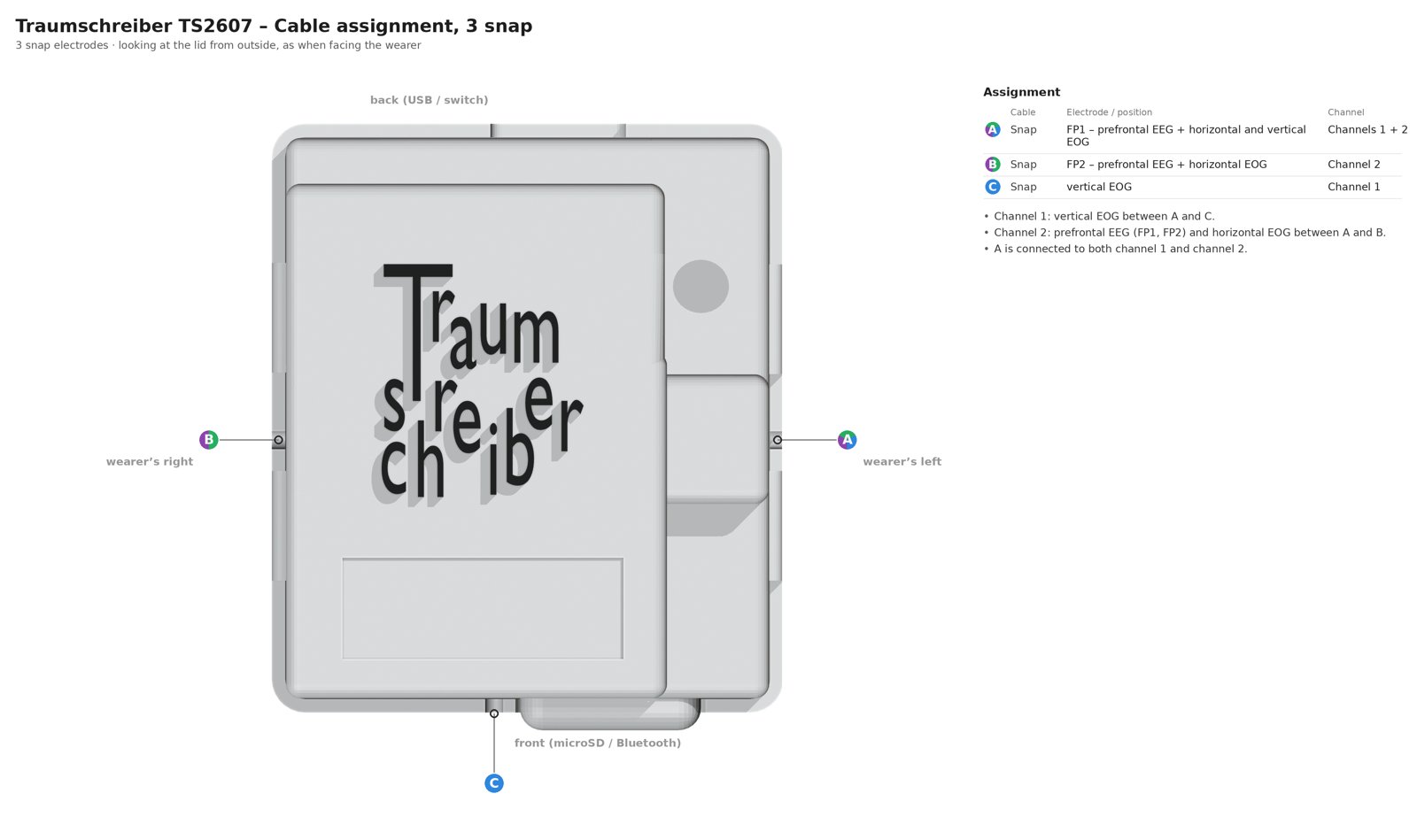
3 leads · two channels. Like the standard configuration, plus a third snap electrode on the cheekbone for vertical EOG (channel 1). This records eye movements in both directions – the basis for 2D EOG and dream painting.
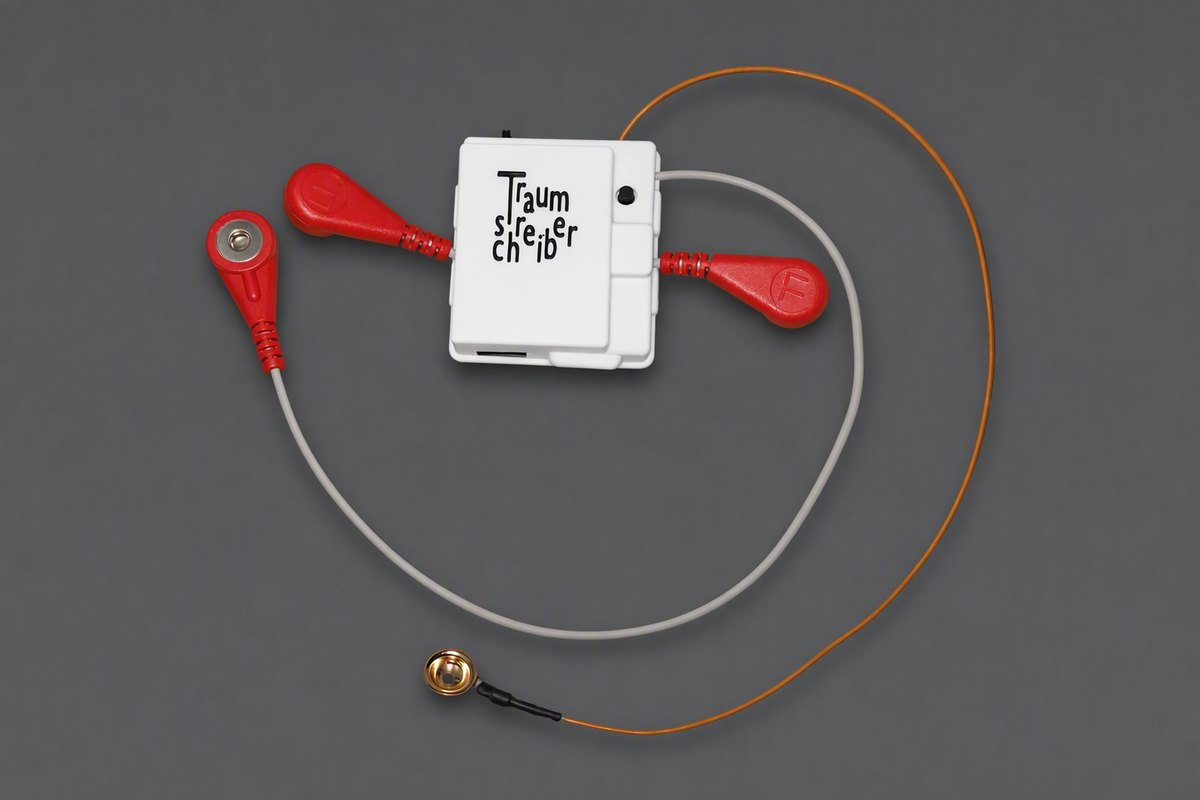
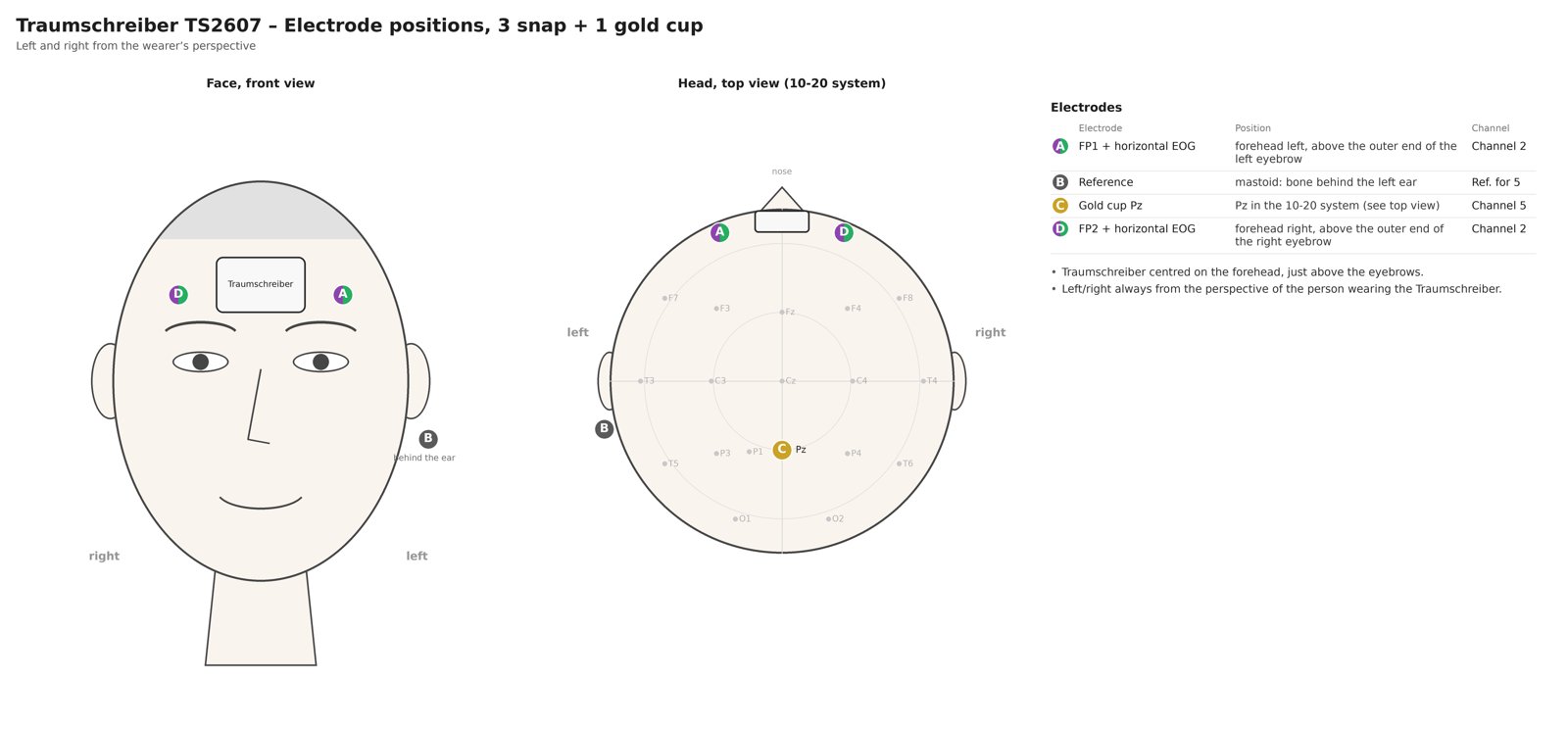
4 leads · two channels. Forehead EEG and horizontal EOG as in the standard configuration, plus a gold-cup electrode on the back of the head (Pz, channel 5) with a snap reference behind the left ear. We used this configuration for the P300 measurement.
Only tested a little so far. We have checked the gold-cup electrode in only a few short measurements; a test over a whole night is still to come. We therefore recommend waiting a little before ordering this configuration, until our internal tests are complete. If you are in a hurry, you can of course order it now.
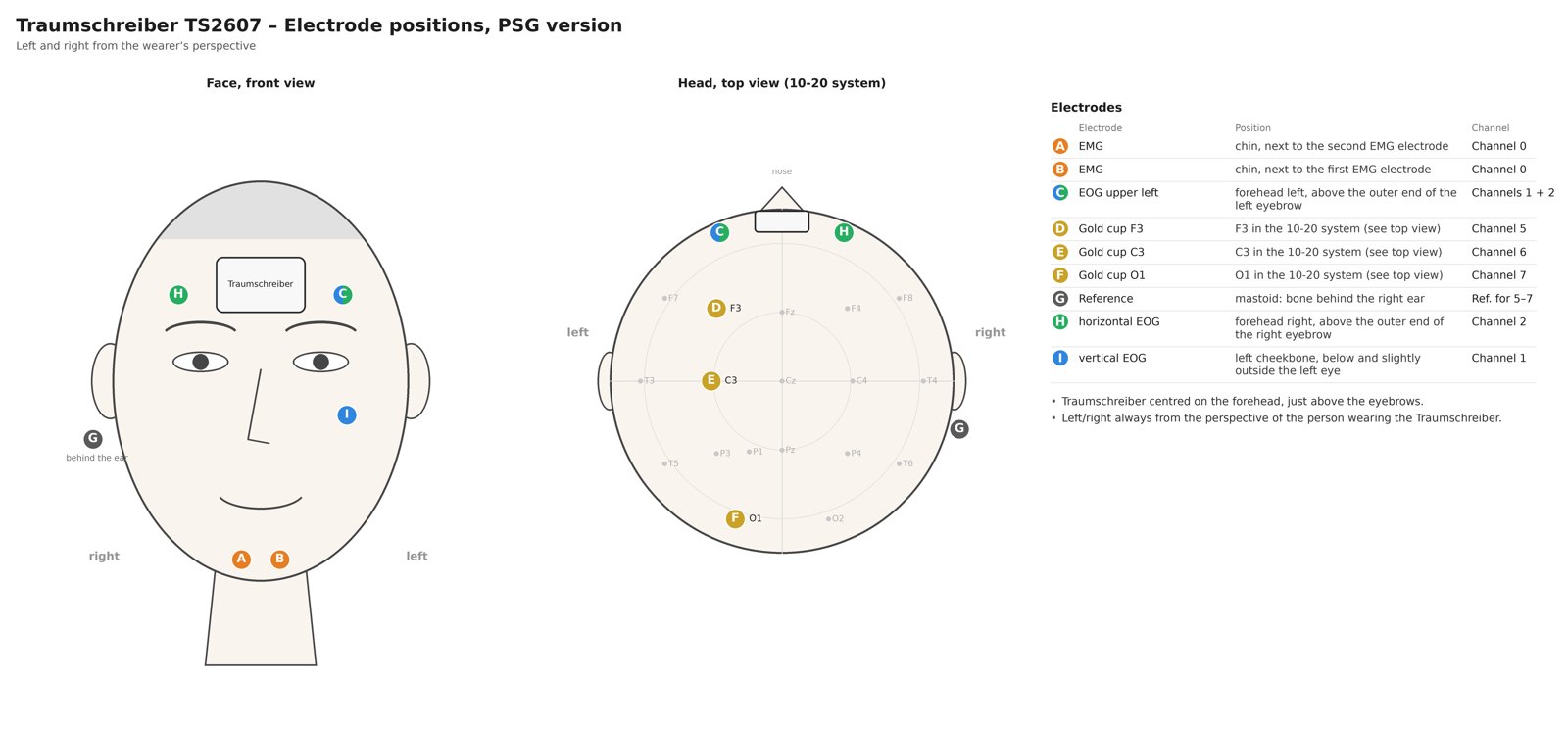
9 leads · six channels. The setup for polysomnography: chin EMG (channel 0), vertical and horizontal EOG (channels 1 and 2) and EEG at F3, C3 and O1 via gold-cup electrodes against a reference on the right mastoid (behind the right ear) (channels 5–7).
Hardly tested so far. So far we have mainly checked the PSG version electrically; measurements over whole nights are still to come, and the gold-cup electrodes have only been tested a little. We therefore recommend waiting a little before ordering this configuration, until our internal tests are complete. If you are in a hurry, you can of course order it now.
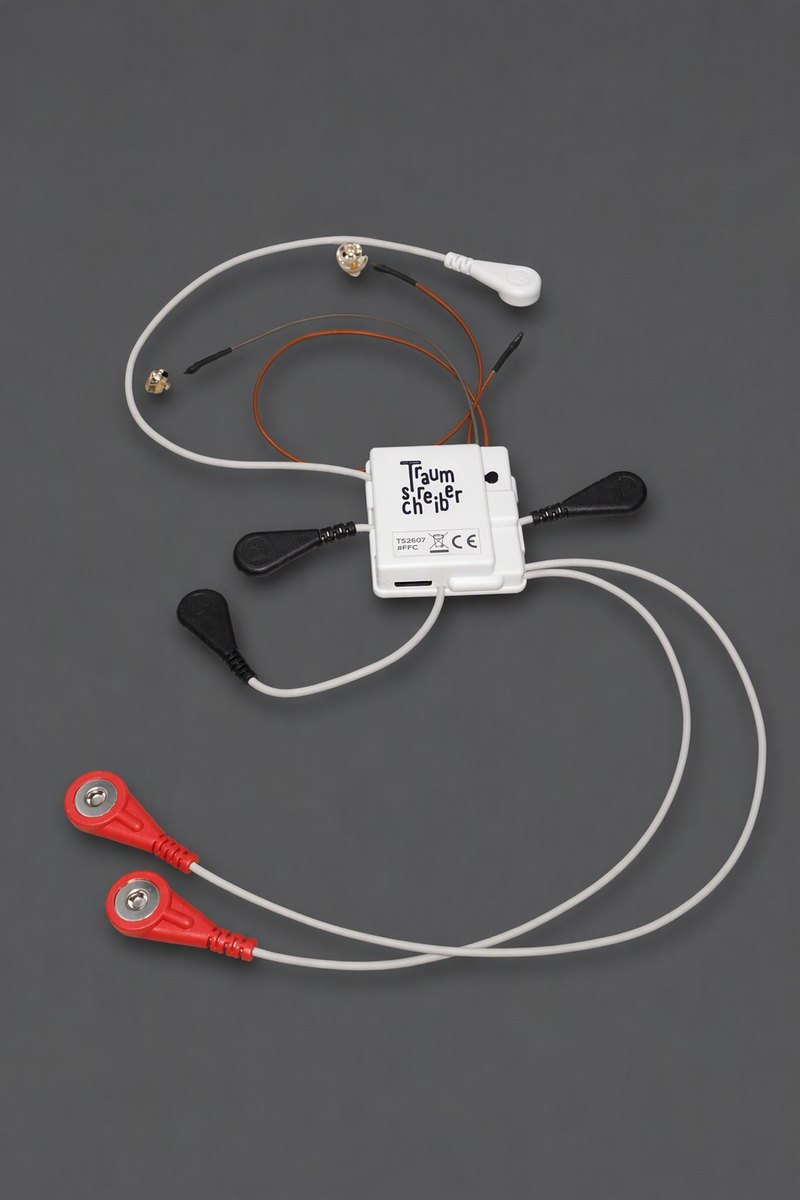
Other lead lengths or your own electrode layout? We solder them on at the factory by arrangement. Just tell us in the request form.
Technical data
| Model | Traumschreiber TS2607 |
|---|---|
| Signals | EEG, EOG, EMG, ECG – depending on electrode placement |
| Channels | 8 differential ExG channels (ADS131 family front end) |
| Sampling rate | 250 Hz |
| Further sensors | Microphone, ambient light, button, battery voltage |
| Outputs | RGB LED, small speaker (fairly quiet; e.g. for light and sound cues) |
| Storage | microSD card (inserted at the factory) and in parallel in the app |
| Data format | EDF/BDF (open standard) |
| Radio | Bluetooth Low Energy (nRF52840) |
|---|---|
| Battery | LiPo 3.7 V / 560 mAh – lasts two to three nights without recharging |
| Charging | USB-C, 5 V; charging time approx. 2.5–3 hours |
| Dimensions | approx. 55 × 45 × 17 mm |
| Weight | approx. 41 g |
| Housing | PETG, 3D-printed |
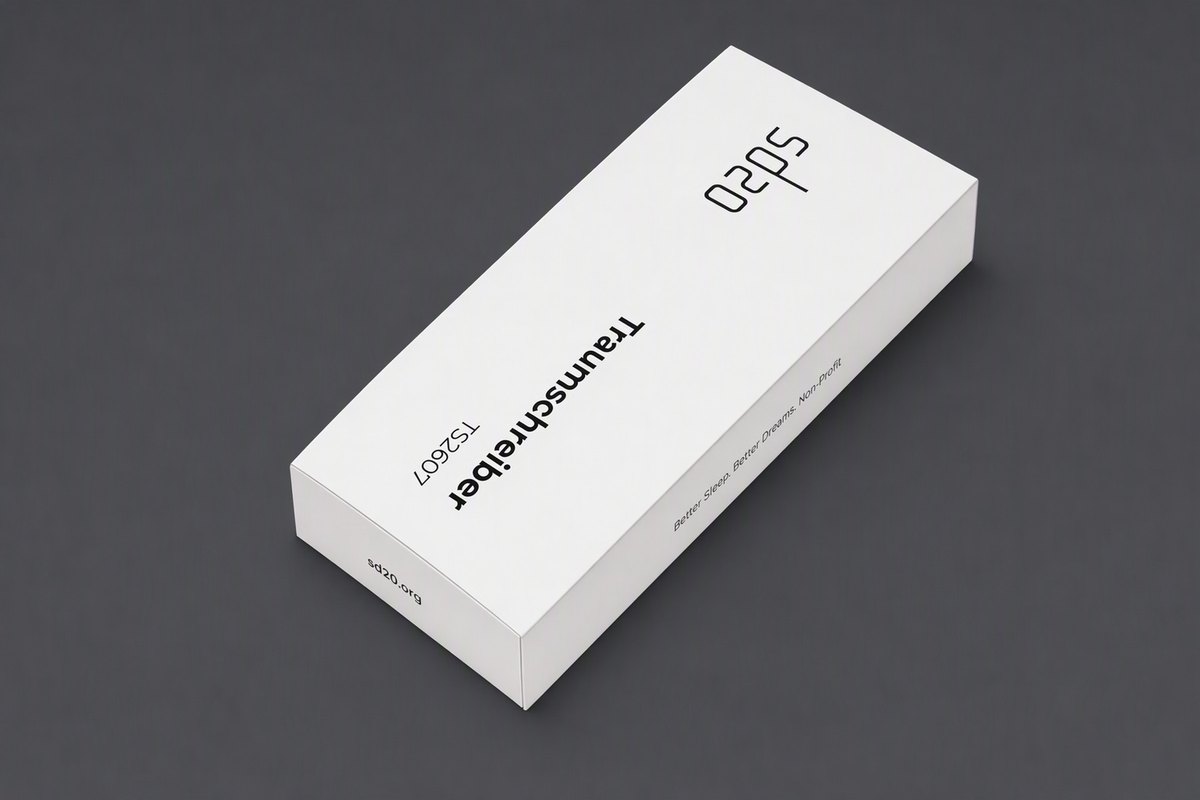
| In the box | Device with leads soldered on, inserted microSD card, adhesive snap electrodes for the first nights, quick guide. No USB-C cable. Gold-cup electrodes also need electrode paste (not included). |
| Software | sd20 App (Android), Python scripts for analysis |
Important: while the Traumschreiber is on your body, it must not be connected to the charging cable. Either charge or measure, never both.
Getting started with the Traumschreiber
Our free tutorial guides you step by step from switching on for the first time to analysing a whole night.
Get to know the device
Switch on, read the battery level, charge, make a first ECG recording and open the file in EDFbrowser.
Understand the signals
Analysis with Python, eye movements (EOG), brain waves (EEG) and muscle activity (EMG).
Analyse
Calculate heart rate variability and divide a whole night into sleep stages with AnySleep.
Prices
As a non-profit organisation, we want everyone to be able to afford a Traumschreiber. That is why our prices are tiered. The standard configuration has two electrodes. Every further electrode we solder on costs 15 € extra – snap or gold-cup alike.
| Configuration | Social pricelow income | Private person | Institution |
|---|---|---|---|
| 2 snap (standard)2 leads | 99 € | 150 € | 250 € |
| 3 snap3 leads · +15 € | 114 € | 165 € | 265 € |
| 3 snap + 1 gold-cup4 leads · +30 € | 129 € | 180 € | 280 € |
| PSG version: 6 snap + 3 gold-cup9 leads · +105 € | 204 € | 255 € | 355 € |
All prices are final prices in euros including VAT, shipping, microSD card and a starter set of adhesive snap electrodes for the first nights.
Gold-cup electrodes: The configurations with gold-cup need further accessories such as electrode paste. These are not included and have to be bought separately.
Buying more snap electrodes
You can also get adhesive snap electrodes from us: 10 € per bag of 50, i.e. 20 cents per electrode. Simply add them in the request form of the sd20 Factory.
Who gets the social price?
People with a low income, for example students who receive state financial aid (such as BAföG in Germany). Being a student alone does not qualify – only having little money does. We trust you – please choose the social price only if it is meant for you. The more people pay the regular price, the cheaper we can offer the Traumschreiber to everyone else.
Order
- Send us an order request via the request form of the sd20 Factory – together with snap electrodes or leads if you like. It costs nothing and commits you to nothing.
- Within 24 hours we reply by e-mail: whether your Traumschreiber is in stock and when we can deliver, with the invoice.
- If that suits you, you transfer the amount. Once paid, we ship your Traumschreiber to you.
Delivery: Production starts on 1 November 2026. We currently expect a delivery time of 1 to 2 weeks; we will give you the exact delivery date in our reply to your request. We currently only deliver within Germany. For delivery to another country, please send us a request anyway and we will see whether we can find a solution.
Preselect a configuration: 2 snap (standard) · 3 snap · 3 snap + 1 gold-cup · PSG version: 6 snap + 3 gold-cup
Questions first? Write to us at info@sd20.org.